What can you expect from this habit-breaking guide
How can you break the bad habit, you want to get rid of? It is defined by yourself. You have to remove it yourself, if possible. is it? Most people blame themselves for failing to break bad habits, attributing the collapse to weak willpower or insufficient discipline. But this diagnosis misses a crucial truth: your brain has engineered these patterns specifically to resist your efforts at change. Understanding why habits are designed to stick—and how your brain’s energy management system makes this possible—transforms what feels like personal failure into a solvable problem. This is particularly relevant when considering The Habit You Want to Break.
Examining the mechanisms behind the things we accept without question
The bad Habit You Want to Break Is Working Exactly as Designed: Against You
The Myth of the Weak Will
Every year, millions of people make the same discovery. They decide to change something — stop smoking, eat differently, stop reaching for the phone at midnight, stop saying yes when they mean no. They try. They fail. They try again. They fail again. And then, because this is what the story demands, they conclude that the problem is them. Not enough discipline. Not enough motivation. Not enough willpower. This conclusion is wrong. And it is wrong in a way that matters, because the wrong diagnosis leads to the wrong cure. You are not failing to break your bad habit ir two because you are weak. You are failing because your brain has built a system specifically designed to make sure you don’t.That system is not a flaw. It is one of the most sophisticated pieces of engineering in the known universe.Understanding it will not make change easy. But it will make it possible in a way that blaming yourself never will.
What a Habit Actually Is
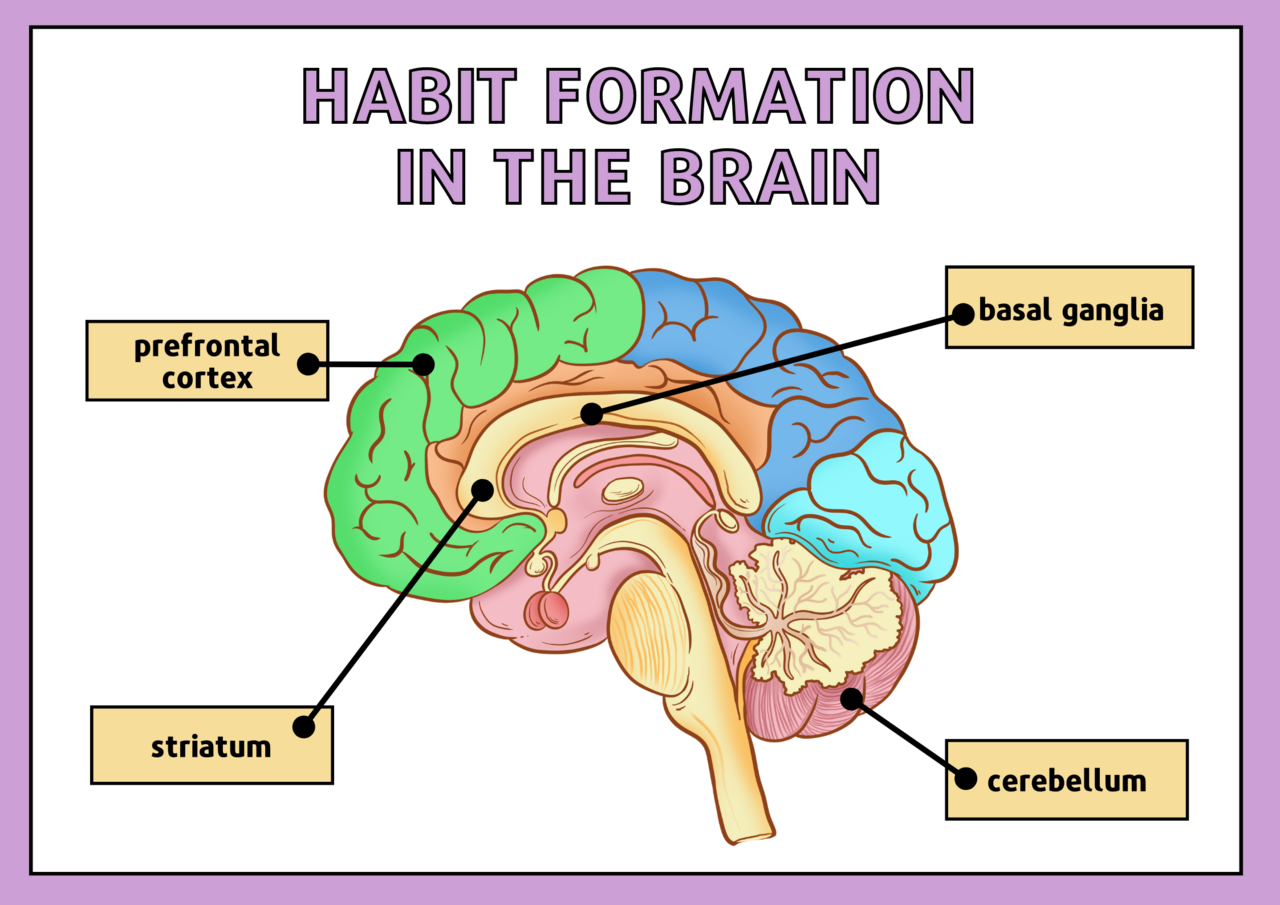
The common description of habit — a loop of cue, routine and reward — is accurate but incomplete. It describes what a habit does. It doesn’t describe what a habit is. A habit is a compressed decision. The brain’s primary job is not thinking. It is energy management. The human brain accounts for roughly 2% of body weight and consumes approximately 20% of the body’s energy. Every conscious decision, every act of deliberate reasoning, draws on that budget. The brain’s solution to this problem is elegant and ruthless: automate everything that can be automated. When you perform a behaviour repeatedly in a consistent context, the brain begins to transfer control of that behaviour from the prefrontal cortex — the seat of conscious, deliberate thought — to the basal ganglia, a much older and more efficient structure deep in the brain. Once that transfer is complete, the behaviour no longer requires conscious input. It runs on its own, triggered by context, burning almost no cognitive fuel. This is not a bug. It is the feature that allows you to drive a familiar route while having a conversation, to type without looking at your fingers, to navigate your morning routine while still half asleep. Automaticity is the brain’s gift to you — a library of compressed decisions that frees your conscious mind for genuinely novel problems. The problem arrives when the compressed decision is one you no longer want to make.The Lock You Did Not Know Was There
Here is the part that most accounts of habit leave out — and it is the part that explains everything. When the basal ganglia takes over a behaviour, it does not simply learn to run that behaviour automatically. It simultaneously learns to suppress the alternatives. This is called inhibitory control, and it is active, not passive. Your brain does not merely run the habit on autopilot. It actively blocks the competing impulses — the ones that would interrupt the loop, redirect your attention, or produce a different behaviour in the same context. The inhibition fires before conscious thought has a chance to intervene. By the time you are aware you are reaching for the cigarette, the phone, the biscuit, the drink, the suppression of the alternative has already happened.You are bringing a philosophical argument to a neurological gunfight.This is why willpower fails so consistently and so dramatically. Willpower is a conscious, prefrontal cortex function. The inhibition is subcortical — it happens below the level of conscious awareness, in structures that predate language, reflection and the capacity for self-improvement by hundreds of millions of years. The brain is not on your side when you try to change. It is defending a decision it made, correctly, on your behalf — that this behaviour is efficient, contextually reliable, and should be protected from interference. Including yours.
Why Context Is the Real Trigger
Understanding inhibitory control changes where you look for the solution. Most people trying to break a habit focus on the moment of temptation — the instant when the cue fires and the behaviour begins. They try to intervene there, in the gap between cue and action, with a burst of conscious effort. This strategy fails for the reason described above: by the time you notice the temptation, the suppression of alternatives has already run. You are fighting after the bell. The research on habit change consistently points to a different intervention point: the context. Habits are not just behaviours. They are context-behaviour pairs. The cue is not abstract — it is specific. The particular chair. The specific time of day. The smell of the office kitchen. The sound of a notification. The route you drive home. The brain has learned not just the behaviour but the entire sensory context in which the behaviour belongs, and the inhibition fires when that context is detected.This is why the most reliably effective habit change tends to happen after a significant life disruption. These events break the context-behaviour pairs at scale.Moving house, changing jobs, having a child, recovering from illness — the cues that used to trigger the suppression of alternatives are simply absent. The window for conscious choice reopens, briefly, before new habits form. You do not have to wait for a life disruption. But you do have to engineer the context, not fight the impulse.
The Mechanism, and What to Do With It
Four principles follow directly from understanding how the system actually works.Change the context before you change the behaviour
If the habit fires in a specific environment, change the environment first. Remove the cues. Rearrange the space. Change the route. Disrupt the sensory triggers that the basal ganglia has learned to recognise. You are not trying to be stronger than the habit. You are trying to make the habit invisible.Replace, do not remove
The basal ganglia does not respond well to absence. A habit loop that ends in nothing — cue fires, routine is suppressed, no reward — produces frustration and a rapid return to the original behaviour. The more durable intervention is substitution: keep the cue, keep the reward structure, change only the routine in the middle. The brain has something to learn. It is far better at updating a habit than erasing one.Reduce the decision load at the point of highest vulnerability
The inhibition fires fastest when you are tired, stressed, cognitively depleted or emotionally activated. These are not the moments to rely on willpower. They are the moments when the automated system is most dominant. The solution is to make the decision earlier, when your prefrontal cortex is functional — remove the temptation from the environment before the vulnerable moment arrives, not during it.Repeat in context, not in isolation
New behaviours become habits through contextual repetition — the same action, in the same environment, at the same time. Motivation, intention and understanding are necessary but not sufficient. The basal ganglia learns from repetition, not from insight. You can understand this entire article perfectly and still need to repeat the new behaviour forty or fifty times in the same context before the transfer of control begins. That is not failure. That is how the system works.The Road Is Not Easier. But It Is Clearer.
None of this makes changing behaviour easy. Working on The Bad Habit You Want to Break takes dedication, but then it is doable. Understanding the mechanism is the tool to break free.The inhibition is real, the automaticity is real, and the brain’s preference for efficiency over novelty is a feature of human cognition that no amount of self-knowledge can simply override. But it makes the road clearer. When you understand that your brain is not malfunctioning when you reach for the old behaviour — that it is, in fact, working exactly as designed — you stop wasting energy on self-blame and start directing it at the actual mechanism.
You are not fighting a character flaw. You are navigating an architecture.The architecture can be worked with. It cannot be ignored, overridden by force of will, or shamed into compliance. But it responds, reliably and predictably, to context change, substitution, environmental design and patient repetition.
The bad habit you want to break is working exactly as designed. Now you know the design. Work with it.
Read more
Eight sites, one family — travel, wine, sport and sharper thinking. Explore the rest of the universe.