The Explanatorium on Politics — examining the mechanisms behind the things we accept without question
The Explanatorium on Politics:”I See What You Are Doing
In 1837, a Danish writer from Odense published a short story about collective self-deception so precise in its mechanism that nearly two centuries later it still describes the nightly news with uncomfortable accuracy. We choose in light of it s relevance today to define it thus: Hans Christian Andersen Wrote the Best Political Handbook ever.
Hans Christian Andersen’s The Emperor’s New Clothes is not really a story about a foolish emperor. It is a story about what happens when an entire society agrees — silently, individually, simultaneously — to pretend that something false is true. The emperor parades through the capital wearing nothing. His ministers see nothing. The crowd sees nothing. And yet the procession continues, because the social cost of saying what you see is higher than the cost of looking the other way.
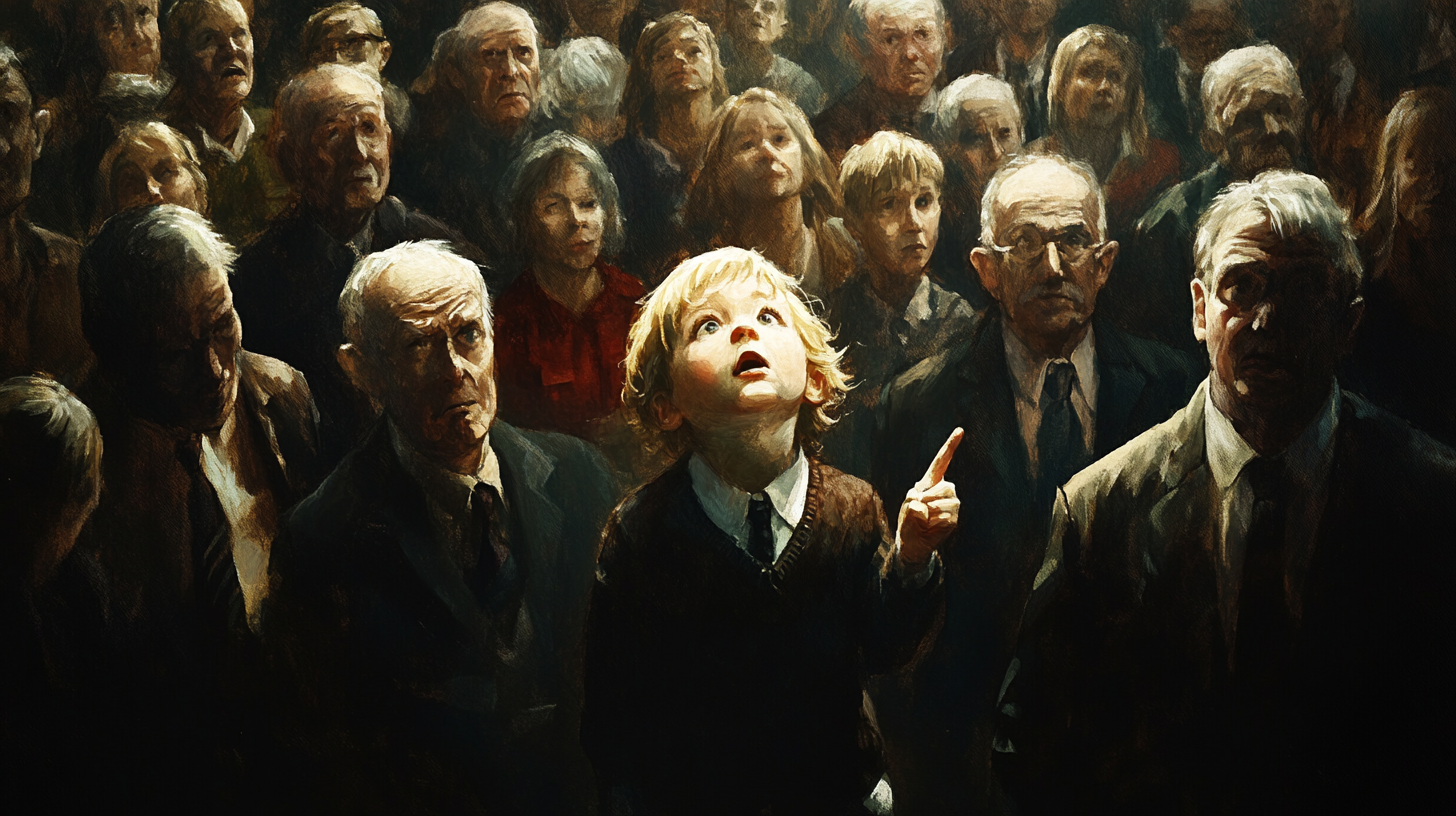
Until a child speaks.
“But he hasn’t got anything on!”
Simple. Blunt. Devastating. And the moment the child says it, everyone who already knew could finally say it too.
We tend to read this story as a lesson about the emperor’s vanity, or the swindlers’ cunning. But Andersen buried the darkest detail quietly, almost in passing: the emperor himself suspected the truth. When the crowd finally cried out, he had an inkling that they were right — but he thought, “I must bear up to the end.” And so he walked on, more proudly than before. The chamberlains behind him held up the train that was not there with even greater dignity.
The emperor knew. He chose to continue anyway.
Sound familiar?
Why Charm Is a Perfectly Rational Trap
Before accusing voters of stupidity, it is worth understanding why charm works so reliably as a political tool — because it is not a flaw in human cognition. It is a feature.
For the overwhelming majority of human history, the people with power over your life were people you actually knew. Your chieftain, your landlord, your guild master, your priest. In those contexts, reading a person’s character through their warmth, their humour, their physical presence, their eye contact — this was entirely reasonable. These signals carried genuine information. A leader who made you laugh probably wasn’t about to have you executed. Someone who looked you in the eye was probably not lying to your face.
These are called heuristics — cognitive shortcuts that work well enough, often enough, that evolution kept them. They are not stupidity. They are efficiency.
The problem is that modern electoral politics is one of the very few environments specifically engineered to exploit them.
The Explanatorium on Politics looks under the political hood.
The spin doctor’s entire profession is the manufacture of trustworthiness signals. The debate coach teaches the candidate to hold eye contact for precisely the right duration. The speechwriter engineers the self-deprecating joke that makes the candidate seem human. The stylist adjusts the collar. The lighting technician warms the skin tone. The campaign manager books the factory visit, the school visit, the hospital visit — not because any of these encounters will change policy, but because the images they generate trigger the ancestral circuits that say: this person is one of us, this person can be trusted.
You are not being fooled because you are naive. You are being fooled because extremely intelligent people are paid enormous sums of money to fool you using tools your brain cannot easily override.
That is a very different diagnosis. And a different diagnosis leads to a different cure.
The Mechanism of Collective Silence
Return to Andersen for a moment, because he understood something about crowds that most political scientists still struggle to articulate cleanly.
Every single adult in that story could see the emperor had nothing on. The minister sent to inspect the cloth saw nothing — and said nothing, for fear of appearing unfit for his office. The second official sent to check saw nothing — and said nothing, for the same reason. The emperor himself saw nothing — and said nothing. The crowd lining the streets saw nothing — and said nothing.
Each person made an individual calculation: the social cost of speaking is higher than the cost of silence. And because every person made this calculation, the collective result was a roaring, unanimous endorsement of a lie that nobody believed.
This is not ancient history. It is the mechanism behind every applause line at every political rally where the audience knows, somewhere beneath the noise, that what they are hearing is theatre. It is the mechanism behind the editorial meeting where nobody wants to be the one to say the candidate has no real policy. It is the mechanism behind the party faithful who privately roll their eyes but publicly cheer.
The silence is not agreement. It is a coordination failure — everyone waiting for someone else to go first.
Which is precisely why the child’s voice matters so much. The child does not calculate social cost. The child simply says what is visible. And the moment it is said out loud, the crowd is released from the coordination trap. One voice gives permission to every other voice that was already thinking the same thing.
Defence Turned Offence: The Most Powerful Sentence in Democratic Politics
Here is where the informed voter stops being merely a passive observer of manipulation and becomes an active participant in breaking it.
Most civic education focuses on defence — how to identify misinformation, how to check sources, how to resist emotional appeals. This is valuable. But it is incomplete, because defence is a private act. You fact-check at home, alone, and arrive at your conclusion in silence. The collective illusion continues uninterrupted.
The move that actually changes something is to say it out loud.
“I see what you are doing.”
Not as an accusation. Not as aggression. Simply as a statement of clear sight, spoken where others can hear it. This is the defence turned to offence — not because it attacks the manipulator directly, but because it dismantles the one thing manipulation cannot survive: the shared pretence that nobody notices.
Consider the rebuttal this produces: “I don’t vote for you.”
Notice what this is not. It is not anger. It is not a counter-argument that can be spun or deflected. It is not a debate the opponent can win on charm and delivery. It is simply the withdrawal of consent — calm, final, and entirely beyond the reach of the performance.
You cannot charm someone who has already named the charm. You cannot manufacture trust with someone who has already identified the manufacturing process.
This is what makes the move so clean. The emperor’s entire authority rested on the procession continuing. The moment the child spoke, the procession became absurd. The emperor did not fall because someone argued against him. He fell because someone declined to participate in the fiction.
The Extra Mental Mile: What Informed Voting Actually Looks Like
So what does the extra mental mile actually require in practice? Not a doctorate in political science. Not hours of research before every election. The cognitive tools are simpler than that — and they transfer.
Ask what is missing, not what is said
Political communication is a masterclass in strategic omission. The charming anecdote about the struggling family is real. The policy that would help them is absent. Train yourself to notice the gap between the emotional content and the substantive content of what you are being told. The question is not did that story move me? but what specifically will change if this person governs?
Distinguish the person from the position
Likeability is a genuine quality. It is simply not a policy. A candidate can be warm, funny, relatable and entirely without viable ideas. These are not mutually exclusive. Evaluate them separately. Do I find this person likeable? is a fair question. Does that answer my question about what they will do? is the follow-up that matters.
Name the technique, not just the conclusion
The most effective version of the defence-turned-offence move is specific. Not “you are lying” — which is an accusation that triggers defensiveness — but “that story is designed to make me feel rather than think, and I notice it.” Naming the mechanism rather than the motive is harder to dismiss. It is also more honest — you are not claiming to know intent, only to recognise effect.
Make your reasoning visible: The Explanatorium on Politics will do so
The child in Andersen changes everything not by thinking clearly but by speaking. The value of the informed vote is multiplied when it is expressed — in conversation, in the comments, across the dinner table. You are not just protecting your own decision. You are giving the crowd permission to say what it already suspects.
The Child You Were, the Voter You Can Be
There is something worth sitting with here about the nature of that child’s clarity in Andersen’s story.
The child does not have more information than the adults. The child has less. What the child has is the absence of a particular kind of learned behaviour — the social calculus that says the cost of being the one who says it is too high. The child has not yet been taught that the emperor’s dignity requires protection, that the swindlers’ reputation must not be questioned, that the procession must not be interrupted.
The child simply sees what is there. And says so.
The extra mental mile is not about becoming more sophisticated. In some ways it is about becoming less — stripping back the accumulated layers of social performance and asking the question that should always have been first: is this actually true?
Andersen published his story in 1837, alongside The Little Mermaid, in a collection of fairy tales for children. He was, of course, writing for adults. He was writing about a court in which everyone — emperor, minister, courtier, crowd — had made an individual decision that visibility was dangerous, and that the procession was safer than the truth.
He was writing about now.
The informed voter is the child in the crowd who has chosen, consciously and deliberately, to reclaim that original clear sight. Not out of naivety. Out of the considered decision that the procession has gone on long enough.
“But he hasn’t got anything on.”
Say it. Say it where others can hear you.
The chamberlains will keep holding up the train. But the crowd will know.