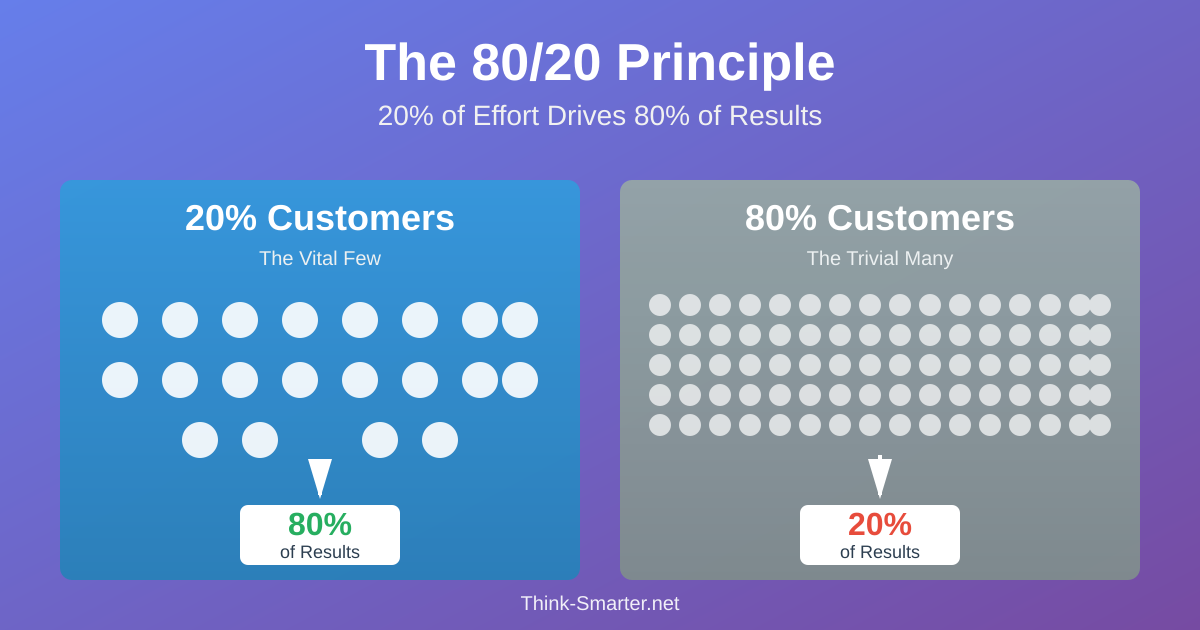
The 80/20 Rule: Work Smarter, Not Harder
How the Pareto Principle Can Transform Your Productivity, Business, and Life. Think smarter – not harder.
Most of what you do doesn’t matter. This isn’t pessimism—it’s liberation. The 80/20 rule reveals a profound truth: roughly 20% of your efforts produce 80% of your results. Master this principle, and you’ll accomplish more by doing less, focusing on what truly moves the needle while ruthlessly eliminating the rest.
What Is the 80/20 Rule?
The 80/20 rule—formally known as the Pareto Principle—states that approximately 80% of outcomes come from 20% of causes. In other words, so Think smarter – not harder.
20% of your input creates 80% of your output.
80% of your input creates only 20% of your output.
This isn’t just a productivity hack—it’s a fundamental pattern that appears throughout nature, economics, business, and human behavior. Understanding and applying this principle is perhaps the single most powerful leverage point for improving your effectiveness in any domain.
The 80/20 Principle in Action
Real Example: Customer Revenue Distribution
Company XYZ: 100 Customers
Annual Revenue: $1,000,000
20% of Customers
(20 customers)
$800,000
80% of Revenue
THE VITAL FEW
Average: $40,000 per customer
80% of Customers
(80 customers)
$200,000
20% of Revenue
THE TRIVIAL MANY
Average: $2,500 per customer
💡 Focus on your top 20% customers – they drive 80% of your business!
What This Means in Practice
⭐ The Vital 20%
- 20 customers generate $800,000
- Average value: $40,000 per customer
- These are your VIP accounts
- Strategy: White-glove service, dedicated account managers, priority support
- ROI: Investing 80% of your service resources here maximizes returns
📊 The Trivial 80%
- 80 customers generate only $200,000
- Average value: $2,500 per customer
- These are low-value, high-maintenance accounts
- Strategy: Self-service portals, automated support, standard service
- ROI: Don’t over-invest resources here – automate or delegate
🎯 The Action Plan
- Identify your top 20%: Rank customers by revenue, profit, or strategic value
- Allocate resources accordingly: Give 80% of your best people and attention to top 20% of customers
- Upgrade the vital few: Can you turn $40K customers into $80K customers? (Easier than finding 20 new customers!)
- Streamline the trivial many: Automate service, raise prices, or let unprofitable customers go
- Focus acquisition: Find more customers like your top 20%, not like your bottom 80%
💎 The Uncomfortable Truth
If you treat all 100 customers equally, you’re underserving your best customers and overserving your worst.
The vital 20% deserve 80% of your attention. The trivial 80% should get automated, efficient service with 20% of resources.
This isn’t unfair—it’s strategic. Focus creates excellence.
The Core Insight
The implication is radical: most of what you do has minimal impact. The majority of your time, effort, and resources are spent on activities that contribute little to your desired outcomes. Conversely, a small fraction of your activities drive the vast majority of your results.
This creates an enormous opportunity: if you can identify your vital 20% and focus relentlessly on that while eliminating the trivial 80%, you can multiply your effectiveness exponentially without working harder.
Who Discovered the 80/20 Rule?
Vilfredo Pareto: The Unlikely Discovery
The principle is named after Vilfredo Pareto (1848-1923), an Italian economist, civil engineer, and philosopher who made the observation that would become one of the most influential concepts in business and productivity: Think smarter – not harder.
The Pea Pod Moment
In 1896, while tending his garden, Pareto noticed that roughly 80% of his pea harvest came from just 20% of his pea pods. This seemingly trivial observation sparked his curiosity.
The Wealth Distribution Study
Pareto then examined wealth distribution in Italy and discovered a striking pattern: approximately 80% of the land was owned by 20% of the population. Intrigued, he studied other countries and found similar distributions across time and geography.
This wasn’t random—it was a fundamental pattern in how resources distribute themselves in complex systems.
Joseph Juran: From Observation to Principle
While Pareto made the observation, it was management consultant Dr. Joseph M. Juran who transformed it into a practical business principle in the 1940s.
Juran coined the term “the vital few and the trivial many” and demonstrated how the 80/20 pattern appeared consistently in quality control: 80% of defects came from 20% of causes. This insight revolutionized manufacturing and quality management.
Juran popularized the term “Pareto Principle” in honor of the Italian economist, though Pareto himself never formulated it as a universal rule.
Modern Recognition
The principle gained mainstream recognition through several influential works:
- Richard Koch’s “The 80/20 Principle” (1997) – Popularized applying the principle to personal productivity and life optimization
- Tim Ferriss’s “The 4-Hour Workweek” (2007) – Applied 80/20 thinking to lifestyle design and remote work
- Greg McKeown’s “Essentialism” (2014) – Refined the concept into “less but better”
How Precise Is the 80/20 Rule?
The Numbers Aren’t Magic
Let’s be clear: the 80/20 split is not mathematically exact. You won’t find precisely 80% and 20% in every situation. The actual distribution might be:
- 70/30 (70% of results from 30% of effort)
- 90/10 (90% of results from 10% of effort)
- 95/5 (95% of results from 5% of effort – common in digital products)
- 60/40 (more balanced, but still imbalanced)
The specific numbers don’t matter. What matters is the principle of imbalance: inputs and outputs are never equally distributed.
Power Law Distribution
The 80/20 rule is a manifestation of what mathematicians call a power law distribution—a relationship where a small number of occurrences account for a large proportion of outcomes.
Power laws appear throughout natural and social systems:
In Nature:
- 80% of earthquakes are produced by 20% of fault lines
- 20% of species account for 80% of biomass
- 80% of volcanic activity comes from 20% of volcanoes
In Human Systems:
- 20% of criminals commit 80% of crimes
- 20% of drivers cause 80% of accidents
- 20% of patients use 80% of healthcare resources
In Business:
- 20% of customers generate 80% of revenue
- 20% of products drive 80% of sales
- 20% of employees create 80% of value
- 20% of bugs cause 80% of software crashes
Scientific Validation
The Pareto distribution has been scientifically validated across multiple disciplines:
Economics & Business
Studies consistently show that wealth, income, and business performance follow power law distributions. Research by economists like Thomas Piketty confirms that capital and wealth accumulation exhibit strong Pareto characteristics across nations and eras.
Reference: Piketty, T. (2014). Capital in the Twenty-First Century. Harvard University Press.
Information Theory
George Zipf’s law (a specific case of power law distribution) demonstrates that in any corpus of natural language, the frequency of words follows a power law: a small number of words account for the vast majority of usage.
Reference: Zipf, G. K. (1949). Human Behavior and the Principle of Least Effort. Addison-Wesley.
Network Science
Research on complex networks (social networks, the internet, biological systems) reveals that connections follow power law distributions—a few nodes have massive connectivity while most have few connections.
Reference: Barabási, A. L. (2002). Linked: The New Science of Networks. Perseus Books.
Why the Imbalance?
Power law distributions emerge from systems with:
- Feedback loops: Success breeds success (the rich get richer, popular content gets more popular)
- Network effects: Value increases with participation (platforms, social networks)
- Cumulative advantage: Small initial advantages compound over time
- Resource constraints: Finite attention, time, and resources create competition
These mechanisms are fundamental to how complex systems work, which is why the 80/20 pattern appears so consistently.
How to Use the 80/20 Rule in Your Life
Understanding the principle is valuable. Applying it is transformative. Here’s how to leverage the 80/20 rule across every domain of life:
The 80/20 Analysis Process
Step 1: Identify Your Activities
List everything you spend time on—work tasks, relationships, habits, projects, clients, products, content, meetings. Be comprehensive and honest.
Step 2: Measure Results
Quantify the outcomes from each activity. Use relevant metrics:
- Business: Revenue, profit, customer satisfaction, growth
- Career: Promotions, raises, recognition, skill development
- Personal: Happiness, health, relationships, fulfillment
- Projects: Progress toward goals, impact, learning
Step 3: Calculate the Ratio
Rank your activities by results and identify the vital 20% that produce 80% of your desired outcomes. Often, you’ll find an even more extreme ratio—perhaps 10% of activities drive 90% of results.
Step 4: Double Down on the Vital 20%
Once identified, invest disproportionately in your high-impact activities:
- Allocate more time
- Improve execution quality
- Systemize and scale them
- Remove obstacles
- Invest in skill development
Step 5: Eliminate the Trivial 80%
Be ruthless with low-impact activities:
- Eliminate: Stop doing them entirely
- Automate: Use technology to handle them
- Delegate: Give them to someone else
- Minimize: Do the bare minimum required
Domain-Specific Applications
Business & Entrepreneurship
Customer Analysis:
- Identify your top 20% of customers by revenue
- Focus sales and marketing efforts on acquiring similar customers
- Provide exceptional service to high-value clients
- Consider firing bottom 20% of unprofitable customers
Product/Service Portfolio:
- Determine which 20% of products drive 80% of profit
- Double down on winners, discontinue losers
- Simplify offerings to focus resources
Marketing:
- 20% of channels drive 80% of customer acquisition
- 20% of messages generate 80% of engagement
- 20% of content attracts 80% of traffic
- Focus on what works; stop everything else
Career & Work
Task Management:
- 20% of your work drives 80% of your results and recognition
- Identify high-leverage tasks (strategy, key projects, relationship-building)
- Delegate or eliminate low-leverage tasks (admin, reporting, routine emails)
Skill Development:
- 20% of skills provide 80% of career value
- Focus on developing high-leverage skills (communication, critical thinking, specialized expertise)
- Become world-class in your vital 20%
Meetings:
- 20% of meetings produce 80% of value
- Decline or delegate attendance at low-value meetings
- Make critical meetings exceptional
Personal Life
Relationships:
- 20% of relationships provide 80% of emotional support and joy
- Invest deeply in your vital relationships (family, close friends, mentors)
- Gracefully reduce time with energy-draining relationships
Health & Fitness:
- 20% of habits deliver 80% of health benefits
- Focus on fundamentals: sleep, strength training, whole foods, stress management
- Skip fitness fads and marginal optimizations
Learning:
- 20% of learning activities drive 80% of knowledge retention and application
- Focus on deliberate practice, real-world application, and teaching others
- Minimize passive consumption (videos, articles without application)
Happiness:
- 20% of activities generate 80% of your joy
- Identify what truly makes you happy (not what “should”)
- Design your life around these activities
Time Management
The 80/20 Schedule:
- Block 80% of your best hours for vital 20% activities
- Batch low-value tasks into small time blocks
- Protect high-leverage time ruthlessly
Energy Management:
- 20% of your day holds 80% of your energy and focus
- Schedule your most important work during peak hours
- Do trivial tasks during low-energy periods
Common Mistakes
Mistake 1: Assuming Equal Distribution
Most people allocate time and effort equally across all activities. This is fundamentally wrong. Impact is never evenly distributed.
Mistake 2: Being Too Democratic
Treating all customers, products, or tasks equally feels fair but wastes resources. Focus creates leverage.
Mistake 3: Neglecting to Measure
Without measurement, you’re guessing at your vital 20%. Track results rigorously.
Mistake 4: Failing to Act
Identifying your 20% means nothing without ruthlessly eliminating the 80%. Be willing to say no, delegate, and cut.
Challenges, Critiques, and Modern Refinements
While powerful, the 80/20 rule isn’t without limitations and criticisms. Understanding these makes you a more sophisticated practitioner.
Valid Critiques
1. Oversimplification
The Critique: Reality is complex. Reducing everything to a simple ratio can lead to naive decision-making.
The Response: True—the 80/20 rule is a mental model, not a law of physics. Use it as a lens, not a formula. The key insight—imbalance between inputs and outputs—remains valid even when the exact numbers vary.
2. Context Matters
The Critique: What’s vital in one context may be trivial in another. The rule doesn’t account for changing circumstances.
The Response: Correct. This is why continuous analysis is essential. Your vital 20% evolves as goals, markets, and life stages change. Re-evaluate quarterly.
3. The Trivial Isn’t Always Eliminable
The Critique: Some low-impact activities are necessary foundations for high-impact work (e.g., administrative tasks, basic maintenance).
The Response: True. The goal isn’t to eliminate all low-leverage activities but to minimize, automate, or delegate them. Focus on doing the bare minimum necessary for the trivial 80% while maximizing the vital 20%.
4. Risk of Tunnel Vision
The Critique: Obsessive focus on the 20% can cause you to miss emerging opportunities in the “trivial” 80%.
The Response: Valid concern. Build in time for exploration and experimentation (Google’s famous “20% time”). Balance exploitation (focusing on known winners) with exploration (discovering new winners).
Modern Refinements
The 64/4 Rule (80/20 Squared)
Apply the 80/20 rule twice: 20% of your vital 20% produces 64% of results (0.20 × 0.20 = 0.04 or 4%). This means just 4% of your activities might drive two-thirds of your outcomes.
Implication: Find your ultra-vital 4% and build your life around it.
The 90/10 Rule in Digital
In digital products and platforms, the distribution is often more extreme:
- 90% of Wikipedia content is created by 10% of users
- 90% of social media engagement comes from 10% of content
- 90% of app revenue comes from 10% of users (or less)
This reflects the winner-take-all dynamics of digital markets and network effects.
The 80/20 of Happiness (Essentialism)
Greg McKeown’s work refines Pareto thinking into “essentialism”—the disciplined pursuit of less but better. The question becomes not “How can I do everything?” but “What is the one thing I can do that will make everything else easier or unnecessary?”
Reference: McKeown, G. (2014). Essentialism: The Disciplined Pursuit of Less. Crown Business.
The 80/20 of Learning (Skill Stacking)
Scott Adams (Dilbert creator) proposed that being top 25% in two or three complementary skills creates rare, valuable combinations—more achievable than being top 1% in one skill.
This is 80/20 thinking applied to comparative advantage: focus on a few skills where you can reach the vital 20% rather than trying to master everything.
Reference: Adams, S. (2013). How to Fail at Almost Everything and Still Win Big. Portfolio.
When the 80/20 Rule Doesn’t Apply
Some domains resist Pareto dynamics:
High-Reliability Systems
In aviation, nuclear power, or medicine, the “trivial” 80% of safety procedures prevents catastrophic failures. Here, excellence requires obsessive attention to details across the board.
Long-Term Relationships
Personal relationships aren’t optimizable through elimination. The “trivial” daily interactions create the foundation for deep connection. Here, consistency matters more than efficiency.
Creative Work
In creative fields, you often can’t predict which 20% will succeed until after the fact. Artists, writers, and innovators need to produce volume; quality emerges from quantity.
Solution: Apply 80/20 to the meta-level—spend 80% of time creating, 20% on administration and promotion.
Your 80/20 Action Plan
Knowledge without action is entertainment. Here’s your practical framework for implementing 80/20 thinking:
Week 1: Awareness
- Track everything you do for one week (time, activities, outcomes)
- Rank activities by results produced
- Identify your suspected vital 20%
Week 2: Measurement
- Quantify outcomes from each major activity
- Calculate actual ratios (might not be exactly 80/20)
- Validate or revise your suspected vital 20%
Week 3: Experimentation
- Double time spent on one vital 20% activity
- Eliminate or delegate one trivial 80% activity
- Measure the impact
Week 4: Optimization
- Based on results, triple down on what works
- Eliminate three more trivial activities
- Begin systemizing your vital 20% for consistency
Ongoing: Iteration
- Review your vital 20% quarterly—it will change
- Continuously look for new trivial 80% to eliminate
- Refine execution quality of your vital few activities
The 80/20 Questions
Ask these regularly:
- “Which 20% of my activities produce 80% of my desired outcomes?”
- “Which 20% of activities cause 80% of my problems?”
- “If I could only work 2 hours per day, what would I do?”
- “What am I doing that someone else could do 80% as well for 20% of the cost?”
- “What would I stop doing if I were diagnosed with a terminal illness?”
The Liberation of Less
The 80/20 rule isn’t about working less per se—it’s about working smart. It’s about recognizing that effort and results are never proportional, that most of what we do contributes little to what we want, and that focus creates leverage.
In a world that glorifies busyness and celebrates “hustle,” the 80/20 principle offers a radical alternative: do less, better. Focus on the vital few. Eliminate the trivial many. Multiply your effectiveness without burning out.
This isn’t just a productivity technique—it’s a philosophy of life. It’s about identifying what truly matters and having the courage to say no to everything else.
The Ultimate 80/20 Insight
Perhaps the most powerful application of the principle is this: 20% of your life will create 80% of your happiness and fulfillment. The question is—are you spending your time there?
Most people don’t. They’re stuck in the trivial 80%—activities that feel productive but deliver little real value. They’re busy, but not effective. Active, but not impactful.
The 80/20 rule is your permission slip to be different. To focus. To cut. To simplify. To do less but accomplish more.
Because in the end, life is too short to waste on the trivial.
Find your 20%. Live there.
References & Further Reading
Foundational Works
- Koch, R. (1997). The 80/20 Principle: The Secret to Success by Achieving More with Less. Currency.
- Juran, J. M. (1951). Quality Control Handbook. McGraw-Hill.
- McKeown, G. (2014). Essentialism: The Disciplined Pursuit of Less. Crown Business.
Scientific Background
- Pareto, V. (1896). Cours d’économie politique. Lausanne: F. Rouge.
- Zipf, G. K. (1949). Human Behavior and the Principle of Least Effort. Addison-Wesley.
- Barabási, A. L. (2002). Linked: The New Science of Networks. Perseus Books.
- Newman, M. E. J. (2005). Power laws, Pareto distributions and Zipf’s law. Contemporary Physics, 46(5), 323-351.
Practical Applications
- Ferriss, T. (2007). The 4-Hour Workweek. Crown Publishers.
- Adams, S. (2013). How to Fail at Almost Everything and Still Win Big. Portfolio.
- Newport, C. (2016). Deep Work: Rules for Focused Success in a Distracted World. Grand Central Publishing.
Advanced Topics
- Piketty, T. (2014). Capital in the Twenty-First Century. Harvard University Press.
- Taleb, N. N. (2007). The Black Swan: The Impact of the Highly Improbable. Random House.
- Gladwell, M. (2008). Outliers: The Story of Success. Little, Brown and Company.