
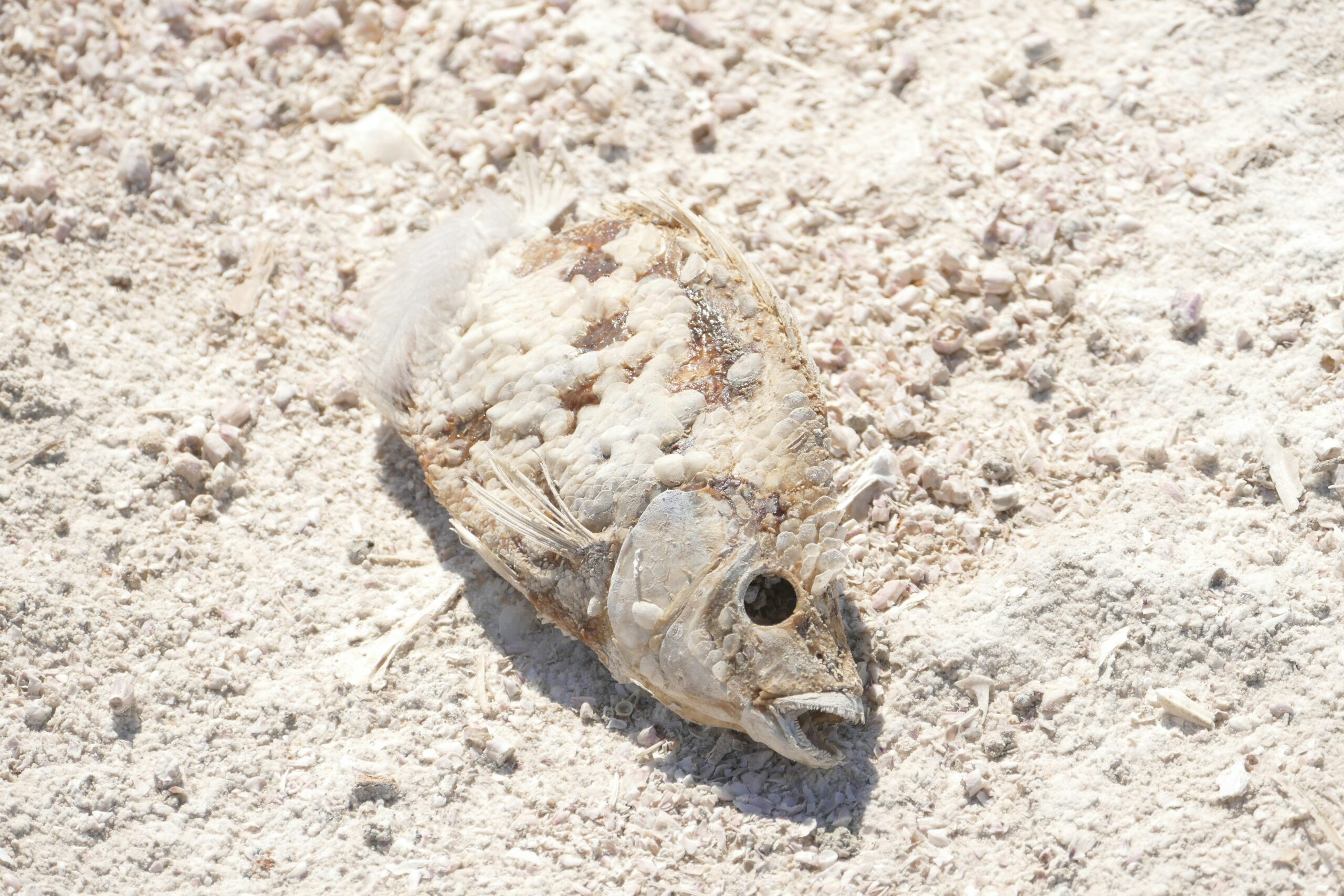
In late summer 2024, an area of Danish sea larger than the island of Zealand ran out of oxygen.
Not polluted in the way people picture pollution. No slick, no drums, no smell on the beach. The water simply stopped containing enough oxygen for anything to breathe in it. In the worst places the seabed began releasing hydrogen sulphide, the gas that smells of rotten eggs and kills almost everything it touches.
Denmark is a green, orderly, wealthy country that thinks of itself as clean. It is also almost entirely made of coastline. And the sea between its islands is in the worst condition anyone has measured for a generation.
So the question in the title is a fair one, and it is asked constantly. It is also, as it turns out, the wrong shape. The answer is more useful than a yes or a no.

What “dying” actually means
A dead zone is not poisoned water. It is suffocated water. The distinction matters more than almost anything else in this subject, so it is worth walking through slowly.
It happens in four steps.
Nitrogen and phosphorus run off farmland and out of sewage systems into the sea. They are fertiliser, and they do in water exactly what they do on land: they make things grow. Algae bloom, in enormous quantities.
The algae die, as algae do, and sink.
On the seabed, bacteria set about decomposing them. Decomposition consumes oxygen. A big enough bloom means a big enough feast, and the bacteria strip the oxygen out of the bottom water faster than it can be replaced.
Then everything that can swim leaves. Everything that cannot — mussels, worms, starfish, the whole quiet infrastructure of the seabed — dies where it sits. And the dying bodies need decomposing too, which uses more oxygen. The process feeds itself.
Past a certain point, a different set of bacteria takes over, ones that do not need oxygen at all. Their waste product is hydrogen sulphide. That is the rotten-egg gas, and unlike the lack of oxygen, it is actively toxic.
Now hold on to the useful part. Nothing in that chain is permanent chemistry. There is no substance that has to be removed, no half-life to wait out. It is a flow. Turn the flow down and the process runs backwards.
How big, and where
In the period from late August to late September 2024, Denmark’s National Centre for Environment and Energy at Aarhus University measured oxygen depletion across 11,000 square kilometres of Danish waters. It was the second largest area ever recorded there. Only 2002 was worse.
The following year did not bring relief. By late August 2025 the affected area was a fifth larger than at the same point in 2024. The share of it suffering severe depletion had climbed from about 30 per cent in July to nearly 40 per cent by August. Hydrogen sulphide was recorded in the worst spots.
Zoom out and Denmark is a small part of a bigger story. The Baltic Sea holds one of the largest human-caused dead zones on Earth, around 70,000 square kilometres. The area of oxygen-starved deep water there has grown roughly tenfold in a little over a century.
Zoom out again and this is not a northern European problem. It happens wherever a large agricultural catchment drains into a sea that does not flush quickly: the Gulf of Mexico below the Mississippi, the northern Adriatic, parts of the Black Sea, coastal China. The recipe is the same everywhere. Fertiliser, a river, and water that sits still.
Why it is getting worse while we use less fertiliser
This is the part that catches people out, and it is the single most important thing in the article.
Denmark has spent thirty years reducing nitrogen losses from agriculture. Real reductions, not paper ones. And the dead zones are getting bigger.
There are two engines, not one.
The first is the nutrients. That is the one everybody argues about, and it is genuine.
The second is heat. Warm water physically holds less dissolved oxygen than cold water — that is not ecology, it is chemistry, and it is not negotiable. Warm water also stratifies more strongly, so the oxygen-rich surface layer mixes down less readily into the bottom water that needs it. The Danish researchers noted that bottom water temperature in 2025 sat above the long-term average in nearly every week of the year.
Put those together and you get the uncomfortable arithmetic. The same quantity of nitrogen does more damage in a warmer sea than it did in a colder one.
Which means the target moves. A reduction that would have been sufficient in 1995 is not sufficient now, and nobody did anything wrong to make that true. Any policy that was designed against the old target is now aiming at a number that has walked away from it.
If you take one habit from this piece, take that one. When something is being fixed and getting worse at the same time, check whether the goalposts are attached to something that is itself moving.
Negligence, stupidity, or cynicism?
That is how the question usually gets asked, and it deserves a straight answer.
The straight answer is that you cannot tell — and more awkwardly, that you would not be able to tell even if you had every fact. Four structural features of this particular problem produce exactly the outcome we see, without requiring anybody to be negligent, stupid or cynical.
There is no author. This is not a pipe. It is tens of thousands of fields, each contributing an amount too small to matter on its own. No single farmer’s restraint would fix it, which means no single farmer’s restraint is rational, which means restraint has to be organised rather than chosen. Problems shaped like that are hard everywhere, in every country, under every government.
The clock is wrong. Nitrogen applied to a field can take years, sometimes decades, to reach the sea through groundwater. Today’s measurements partly record decisions made by people who have since retired. And today’s decisions will not show up in the water for years — which is longer than the term of anyone who makes them. Almost every incentive in the system points at the short horizon, and the sea only responds on the long one.
The gains have names and the losses do not. The benefit of the extra nitrogen goes to a specific person who can tell you what it was worth to them, in kroner, this year. The cost is spread across everyone who might have swum, fished, or simply preferred a living seabed, and none of them can put a number on their share. Concentrated benefit against diffuse cost is the oldest asymmetry in public decision-making, and it wins far more often than it loses.
It is invisible. A dead forest is a photograph. A dead seabed is a line in a technical report. Whatever is easiest to see gets acted on first, and this is one of the hardest things in the natural world to see.
None of that is an excuse, and it is not offered as one. It is something more useful: a reason to be careful about which explanation you pick, because the explanation determines the remedy.
If the cause is bad people, the fix is different people, and you get resignations. If the cause is a structure that produces this result regardless of who is in the chair, the fix is changing the structure — the timescales, who bears the cost, what gets measured and published. Those two roads lead to very different places, and only one of them has ever been shown to work.
Blame is also the most expensive thing in the room. It is the reason this argument has run for thirty years while the numbers got worse. Every hour spent establishing who is at fault is an hour not spent on the flow, and the sea responds only to the flow.
The most awkward good news in marine science
Now the part almost nobody knows, and it changes the whole picture.
By 1990, roughly 40,000 square kilometres of the north-western shelf of the Black Sea — about 80 per cent of it — was effectively dead. Decades of fertiliser coming down the Danube and other rivers had produced the largest dead zone anyone had documented.
Within a decade it was gone.
Nutrient loads fell sharply, algal blooms subsided, oxygen levels recovered, and the animals of the seabed began to return. It stands as the first reversal of a dead zone at that scale anywhere in the world.
Here is the awkward part. It was not a treaty that did it, and it was not a clever intervention. The Soviet Union collapsed. Central and Eastern European agriculture collapsed with it, fertiliser stopped being cheap, and farmers used far less of it because they could not afford it. An economic catastrophe accomplished what environmental policy had not.
Three things follow, and all three are worth keeping.
The first is genuinely hopeful. The sea recovers, and it recovers faster than almost anyone expects. This is not a slow-motion extinction. It behaves like a tap.
The second is sobering. The route taken was one nobody would choose, and it says nothing about whether a deliberate policy can achieve the same thing on purpose.
The third is the one to carry away. The recovery is a controlled experiment nobody meant to run, and it isolated the variable. The nutrients went down and the sea came back. Not the temperature, not the fishing, not the shipping — the nutrients. When someone tells you the causes are too complex and tangled to act on, the Black Sea is the counter-example, and it is not a model or a projection. It happened.

A fjord that died completely, and came back
There is a smaller and more vivid case, and it is Danish.
The summer of 1997 in Denmark was unusually warm, sunny and still. Wind is what mixes oxygen from the air down into the water, and there was almost none.
In Mariager Fjord, the oxygen ran out — not just at the bottom, where it often does, but all the way to the surface, along twenty kilometres of the inner fjord, for about two weeks. The water turned sulphidic from top to bottom. Everything that needed oxygen died, and the corpses drove the oxygen demand higher still.
It is the closest thing to a complete kill in modern northern European waters.
The fjord is not dead. It came back, and scientists documented the revival.
That is not a happy ending, and it should not be read as one — the fjord remains fragile, and the conditions that caused it have not gone away. But it does settle one question. Even total oxygen loss is a state, not a verdict.
What is actually being tried
In November 2024, the Danish parliament passed something genuinely unusual: an agreement between government, farming and environmental organisations that commits around 43 billion kroner to changing how the country’s land is used.
The headline measures are large. Some 140,000 hectares of low-lying farmland are to be converted to nature. Another 250,000 hectares of new forest are planned. The nitrogen target is a reduction of 13,780 tonnes. It also includes what is described as the world’s first tax on agricultural emissions.
Taken together it is the biggest deliberate reshaping of Danish land in a century. It is also, notably, an agreement rather than an imposition, which matters for whether it survives the next few governments.
Denmark is not alone in trying. Nitrogen entering the North Sea from the Rhine has been cut by more than a third through work on sewage and industrial discharge. In Chesapeake Bay, sustained nutrient management brought underwater vegetation back along thousands of kilometres of coast.
Two honest cautions. Nobody yet knows whether the Danish package is large enough, because of the moving target described earlier. And the sea will not show the result for years, which is a serious political problem when the money is being spent now.
So — is the sea dying?
No. And that is not the reassurance it sounds like.
“Dying” describes something happening to a thing, with its own momentum, the way an illness progresses. It invites a particular emotional response: sorrow, and then helplessness, and then not thinking about it any more. It is also, on the evidence, wrong.
The sea is being suffocated. That is a different verb, and it has a subject. It is a flow of nutrients, warmed by a climate we are also changing, and it stops when the flow stops. The Black Sea proved that at scale. Mariager Fjord proved it in miniature.
Which is morally worse and practically much better. Worse, because nothing about it is inevitable and it is happening anyway. Better, because a tap is a thing you can turn.
The reason the sea outside your window is in trouble is not that the problem is mysterious. We know the mechanism, we can measure it every summer, and we have watched it reverse. The reason is that the benefits are visible and immediate while the costs are invisible and delayed, and human institutions are consistently bad at exactly that shape of problem.
Is the Sea Dying: The take away:
Three things, none of which involve feeling worse.
Find out the number for your own coast. In Denmark the oxygen depletion reports are published free by Aarhus University several times each summer, with maps. Most countries with a coast publish something equivalent. A specific local number is worth more than any amount of general concern, and it makes you much harder to fob off.
Watch the baseline. “Improved by 30 per cent” and “healthy” are not the same claim, and the first is often used where the second is meant. Improved compared with when? Against a target set in which decade? Against a sea at which temperature? Ask what the comparison year is, every single time. This is the same discipline as any other claim that arrives pre-digested — see the bullshit detector.
Resist the search for a villain. It is the most natural response and it has the worst record. The farmers did not decide to suffocate the sea. Nor did the officials, or the shoppers who wanted cheap food. What decided it was a structure in which nobody’s individual choice mattered and everybody’s collective choice did. That is a harder story and a duller one. It is also the one with a remedy attached, which the villain story never has.
None of this requires optimism. It requires only the recognition that the thing in front of us is a flow rather than a fate. Everything else follows from how you decide to treat that difference.
Eight sites, one family — travel, wine, sport and sharper thinking. Explore the rest of the universe.


