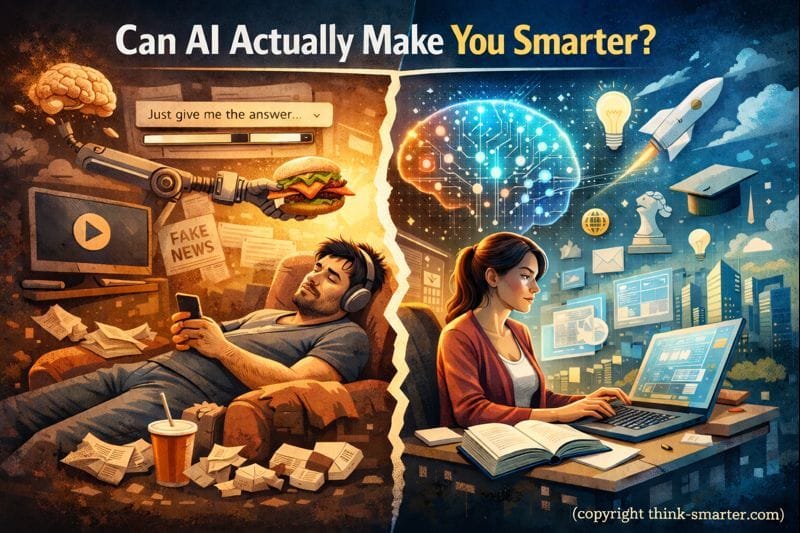
The Question Everyone’s Asking Wrong: Can AI Make You Smarter?
You’ve asked ChatGPT a question. It gave you a confident, detailed answer. You used that answer in your work. And now you’re wondering: Did I just get smarter, or did I just get lazy?
As we delve deeper into the topic, we discover the hidden potential of AI in enhancing our cognitive skills.
When considering the topic, it’s essential to explore the nuances of human cognition in conjunction with AI capabilities.
Go to Gadvisory and take a AI readiness test, insightful
Det new paradigm of thinking
This is genuinely new. We’ve never had tools that could engage with us at the level of ideas, reasoning through problems in something that looks—from the outside—remarkably like collaborative thought.
Exploring the implications of AI’s impact on intelligence is crucial for adapting to a rapidly changing technological landscape.
Ultimately, understanding AI’s role relies on our ability to leverage it as a cognitive partner.
And perhaps most importantly: How do you ensure that as these systems extend your thinking, they don’t diminish your humanity?
These aren’t abstract philosophical questions. They’re practical concerns for anyone who wants to think clearly, work effectively, and make good decisions in a world where AI is increasingly integrated into how we process information and solve problems.
And the big one Will AI take your job?
Will AI take your job?
Therefore, the exploration of AI’s impact on intelligence is not just academic; it’s an essential inquiry for future generations.
Addressing how AI influences our intelligence involves examining the ethical implications of its integration into our lives.
Therefore, the exploration of Can AI Make You Smarter is not just academic; it’s an essential inquiry for future generations.
As we navigate through possibilities, the question will shape our approaches to learning and creativity.
Thus, embracing the query encourages a more informed dialogue about AI’s role in society.
As we navigate through possibilities, the question of Can AI Make You Smarter will shape our approaches to learning and creativity.
By asking ourselves, we open up discussions about the future of human intelligence.
In this context, the topic becomes a pivotal question for anyone engaged in modern knowledge work.
Thus, embracing the query of Can AI Make You Smarter encourages a more informed dialogue about AI’s role in society.
What You’ll Learn in the Full Article
In essence, understanding Can AI Make You Smarter can empower individuals to harness AI’s true potential.Ultimately, exploring Can AI Make You Smarter will enhance our ability to collaborate with intelligent systems effectively.By investigating how Can AI Make You Smarter, we also assess the boundaries of human and artificial intelligence.Consequently, the answer to Can AI Make You Smarter lies in our willingness to adapt and evolve with technology.As we ponder, Can AI Make You Smarter, we must remain vigilant about maintaining our unique human qualities.By asking ourselves, ‘Can AI Make You Smarter,’ we open up discussions about the future of human intelligence.In this context, Can AI Make You Smarter becomes a pivotal question for anyone engaged in modern knowledge work.| Extended Thinking Mechanics | How AI actually extends your thinking (and what that really means) |
| Independent Judgment | Where AI approaches human-level judgment and where it fails spectacularly |
| Error Detection | What errors AI catches reliably and what it misses completely |
| Cognitive Impact | How using AI changes you as a thinker (the question no one’s asking) |
| Best Practices | Eight practical guidelines for optimal human-AI collaboration |
| Natural Language Interface | Why the linguistics matter more than the technology |
| Reality Check | What AI definitively is NOT (despite appearances) |
Reading time: 12-15 minutes | 4,200 words of in-depth analysis
Read more
In summary, the inquiry will resonate as we continue to integrate AI into our daily lives.
Eight sites, one family — travel, wine, sport and sharper thinking. Explore the rest of the universe.