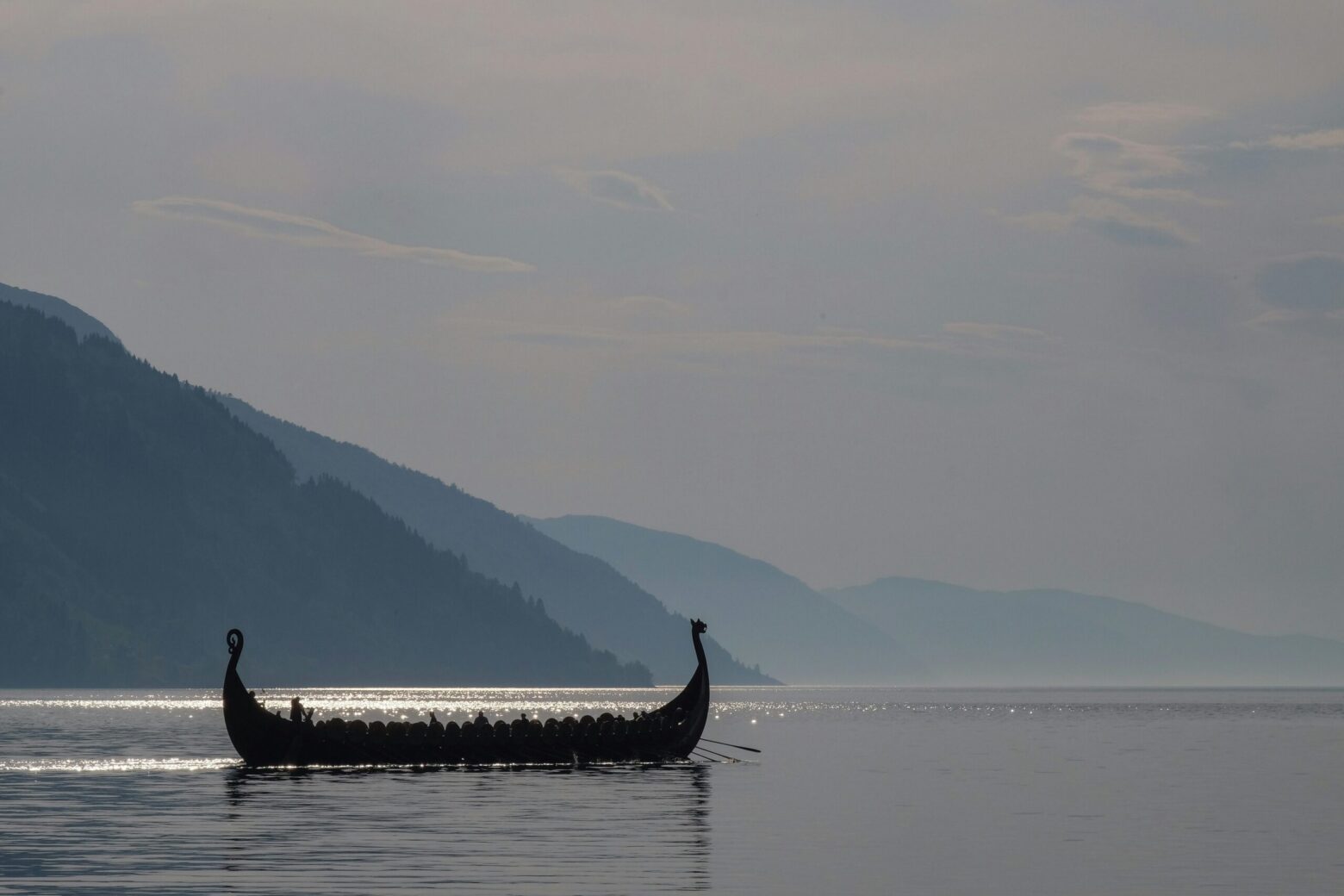
Bluetooth and the viking connection
Somewhere in your pocket, a small radio protocol is quietly named after a Danish king. Bluetooth — the wireless standard connecting your headphones to your phone — takes its name and its logo from Harald Bluetooth, Harald Blåtand, who ruled Denmark from roughly 958 to 986 and, per the runic inscription he had carved on the great stone at Jelling, “won for himself all of Denmark and Norway.” The logo itself is not a stylized “B.” It’s a bind-rune: the Younger Futhark characters ᚼ (Hagall) and ᛒ (Bjarkan), Harald’s initials, fused into one mark. Intel engineer Jim Kardach proposed the name in 1996, during talks between Intel, Ericsson, and Nokia, on the logic that Harald had united Scandinavia the way the new standard was meant to unite competing wireless protocols. Almost nobody who uses it knows this. Which is, in miniature, the whole problem with how the world remembers the Viking Age, and the broader narrative of viking history myth Denmark Norway.
This narrative of viking history myth Denmark Norway has persisted, influencing perceptions far beyond the actual historical context.
The Norwegian brand built in pop culture
Ask most people outside Scandinavia which country the Vikings “belonged to,” and the answer, if they venture one, is usually Norway. The association is not accidental — it has been built, deliberately and effectively, over roughly two decades of popular culture. History Channel’s Vikings (2013–2020), created by Michael Hirst, centers its early seasons on Ragnar Lothbrok, a semi-legendary figure conventionally associated with Norwegian and Danish sagas alike, but staged and marketed with a visual language — fjords, longhouses, raiding parties departing from steep-sided coastal settlements — that reads as unmistakably Norwegian. Ubisoft’s Assassin’s Creed Valhalla (2020) casts its playable protagonist, Eivor, as a Norwegian raider leading a clan out of Norway toward England. Between the two, tens of millions of people absorbed a version of the Viking Age in which Norway is the source and everywhere else is the destination.
It is a good story. It is not, however, a very accurate map of where Viking-era power actually sat.
This narrative often overlooks the complexity of the Viking Age, where viking history myth Denmark Norway intertwine, reflecting a shared heritage that shaped the identity of Scandinavia.
Three raids, three different Scandinavias. Let´s go to 793?
The Viking Age — historians conventionally bracket it between the raid on Lindisfarne in 793 and the Norman Conquest in 1066 — was never a single, unified project with one country at its center. It was three overlapping but distinct expansions, each with its own geography and its own economics. Danish raiders and settlers focused overwhelmingly on England and Francia: they established the Danelaw across eastern and northern England, and by the early eleventh century a Danish king ruled England outright. Norwegian expansion ran west and north — into Scotland, Ireland, the Faroe Islands, Iceland, Greenland, and briefly the coast of Newfoundland. Swedish expansion ran east, up the Baltic river systems into what is now Russia and Ukraine, where Norse traders and warriors known as the Rus’ gave their name to the state that would eventually become Russia, and pushed as far as Constantinople in Byzantine service.
This is not a minor correction. It means that whichever version of “the Vikings” a given culture inherited depends almost entirely on which coastline they were standing on in the ninth century — the English inherited a mostly Danish story, the Irish and Scots a mostly Norwegian one, the Ukrainians and Russians a mostly Swedish one. There was never a single point of origin to inherit from in the first place.
England, in particular, is still quietly speaking Danish without knowing it. More than 1,400 English place names carry Old Norse elements, concentrated precisely where the Danelaw once sat — Lincolnshire, Yorkshire, the East Midlands. The suffix -by, from Old Norse byr, meaning farm or settlement, sits at the end of Derby, Whitby, and Grimsby — the last of which literally means “Grímur’s settlement,” named for a Scandinavian farmer whose own name is otherwise lost. Nobody driving through Yorkshire today thinks of themselves as passing through Danish real estate. But the map is doing the remembering that the popular imagination stopped doing a long time ago.
The Danish king who ruled the North Sea
Harald Bluetooth’s claim to Norway, carved in stone around 965, was not an isolated boast. Two generations later, his descendant Cnut the Great — Knud den Store — became King of England in 1016, King of Denmark in 1018, and King of Norway in 1028, ruling what historians now call the North Sea Empire: England, Denmark, and Norway, plus parts of Sweden, under a single crown, until his death in 1035. This was not a raiding party. It was one of the largest and most stable political entities in eleventh-century Europe, run from Denmark, by a Dane, at a scale neither Norway nor Sweden came close to matching during the same period.
Cnut’s empire did not survive his death by many years — but the pattern it set, Denmark as the senior partner in any Scandinavian union, held for centuries afterward.
Four hundred years, one crown
In 1397, Margaret I of Denmark engineered the Kalmar Union, binding Denmark, Norway, and Sweden under a single monarch. Sweden broke away in 1523. Denmark and Norway did not: the union between them continued, with Norway administered as a subordinate kingdom governed largely from Copenhagen, all the way until 1814 — when the Treaty of Kiel, signed on 14 January that year, ceded Norway to the Swedish crown as one of the settlements following the Napoleonic Wars. Norway then spent a further ninety-one years in union with Sweden before achieving full independence in 1905.
Add it up and the arithmetic is stark: for roughly four hundred of the nine hundred-odd years since the Viking Age ended, Norway was not an independent country at all. It was governed, for most of that stretch, from Denmark. The nation now most strongly associated worldwide with Viking identity spent longer as a Danish territory than the entire Viking Age lasted.
How the quieter country lost the story
None of this makes Norway’s claim on Viking heritage illegitimate — Norwegian sagas, Norwegian shipbuilding, Norwegian westward expansion are all real, well-documented, and central to the period. The interesting question isn’t who has a right to the Viking Age. It’s why one country’s version of it became the default global template while the other’s — despite arguably the stronger political claim — became a historical footnote.
Part of the answer is simply narrative shape. Norway’s Viking story is a story of departure: small, hardy communities pushing outward into open water toward the unknown, discovering Iceland, Greenland, briefly North America. It has a beginning, a direction, and a frontier. Denmark’s Viking-era story is a story of consolidation and administration — a king uniting a kingdom, then ruling an empire, then spending four centuries running a neighboring country’s affairs. Consolidation makes for a duller trailer than discovery does, whatever its actual historical weight. The archaeologist Neil Price, in Children of Ash and Elm: A History of the Vikings (2020), makes a related point about the period more broadly: the Viking Age has always been reshaped by whoever is telling the story to serve the needs of the telling, from Victorian romantics to twentieth-century nationalists to twenty-first-century streaming platforms. The version that travels best is rarely the version that is most complete.
Are you AI ready, take a personal test anonymously
What this pattern is actually about
Zoom out from Scandinavia and the shape becomes familiar. History does not distribute its memory in proportion to political weight. It distributes memory in proportion to whoever tells the better story, tells it more often, and tells it in the medium the next generation actually consumes. Denmark held the crown, the empire, and — for four centuries — Norway’s own government. Norway held the myth. In the long run, in a world where most people’s contact with the ninth century arrives through a streaming subscription rather than a history department, the myth was the more durable asset. The historian Anders Winroth, in The Age of the Vikings (2014), spends much of the book untangling exactly this gap between the archaeological and documentary record and the version of the Vikings that has survived in popular memory — and finds the gap wide almost everywhere he looks.
This is not a uniquely Scandinavian problem. Small, quiet countries with strong but administratively unglamorous historical claims lose the branding contest to smaller, louder, more visually exportable stories with more regularity than most historical education accounts for. The lesson generalizes past Vikings entirely: political dominance and cultural memory are not the same currency, and history offers no exchange rate between them.
Iceland & the EU referendum: the most exposed country in the North Atlantic voted about fish
The rune you are still carrying
The Bluetooth logo sits, unremarked, on billions of devices — a Danish king’s initials, bound into a single mark, doing quiet infrastructural work while a louder, more exportable version of the Viking story runs on every streaming platform a few taps away. Harald Bluetooth united a kingdom that would go on to rule an empire and then govern a neighbor for four hundred years. None of it made it into the trailer. The rune did, by accident, on a phone.
Sources & further reading
- Neil Price, Children of Ash and Elm: A History of the Vikings (Basic Books, 2020)
- Anders Winroth, The Age of the Vikings (Princeton University Press, 2014)
- National Museum of Denmark, The Jelling Stone — the runic inscription and its “won for himself all of Denmark and Norway” text
- Danelaw place-name evidence — over 1,400 English place names of Old Norse origin, concentrated in Lincolnshire and Yorkshire
- Treaty of Kiel, signed 14 January 1814, ceding Norway from Denmark to Sweden
- Cnut the Great’s North Sea Empire (r. Denmark 1018–1035, England 1016–1035, Norway 1028–1035)
- Jim Kardach’s own account of naming Bluetooth, 1996 Intel/Ericsson/Nokia talks — Kardach.com
- Vikings, created by Michael Hirst, History Channel (2013–2020)
- Assassin’s Creed Valhalla, Ubisoft (2020)
Eight sites, one family — travel, wine, sport and sharper thinking. Explore the rest of the universe.